RadioPlan ConnectivityLines: Difference between revisions
Jump to navigation
Jump to search
(Expanded on the documentation of ConnectivityLines) |
(Add new settings property) |
||
| Line 52: | Line 52: | ||
|Color | |Color | ||
|Display color for when we are unable to determine signal level for the radio | |Display color for when we are unable to determine signal level for the radio | ||
|- | |||
|LineThickness | |||
|double | |||
|Line thickness for the rendered lines | |||
|} | |} | ||
Revision as of 13:37, 25 March 2026
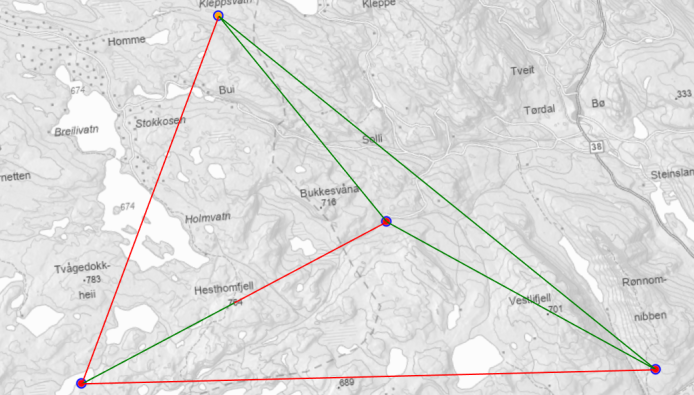
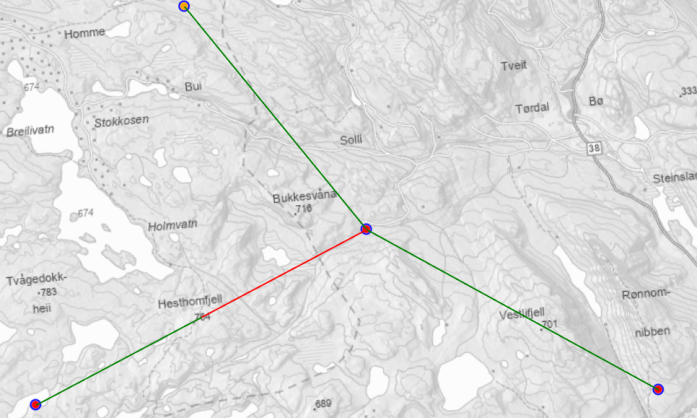
ConnectivityLines visualizes the connectivity between radios within the same RadioNet. It provides a graphical representation of whether radios can communicate with each other based on defined thresholds and network configuration.
The functionality is controlled with the IConnectivityLines interface.
ConnectivityLines supports two modes:
- Without a master radio
- With a master radio
Each connection is represented as a split line:
- One half indicates whether the source (from) radio can reach the target (to) radio.
- The other half indicates whether the target (to) radio can reach the source (from) radio.
Without a Master Radio
When no master radio is configured:
- Connectivity lines are drawn between all possible pairs of radios in the RadioNet.

With a Master Radio
When a master radio is configured:
- Connectivity is only shown between each radio and the master radio.
- No direct connectivity lines are displayed between non-master radios.
- This simplifies the visualization and emphasizes the central role of the master radio in the network.

Settings
| Property | Type | Description |
|---|---|---|
| Threshold | Decibel | Defines the signal strength cutoff for what is considered “coverage.” |
| HasConnectionColor | Color | Display color for has coverage |
| NoConnectionColor | Color | Display color for no coverage |
| HasNoSignalLevelColor | Color | Display color for when we are unable to determine signal level for the radio |
| LineThickness | double | Line thickness for the rendered lines |