RadioPlan Route-Based Best-Coverage
Jump to navigation
Jump to search
This document describes how to use the Route Best‑Coverage extension of the Radio Propagation Coverage API.
The feature allows clients to:
- Submit a geographic route consisting of ordered points.
- Submit a set of radios to consider for coverage.
- Receive, for each point in the route, the radio providing the best coverage.
- Optionally receive a line‑of‑bearing vector from the point to the radio providing the best coverage.
Overview
The API builds on the core coverage calculation engine.
While the base tool computes coverage on a map grid, the Route Best‑Coverage API focuses on answering a different type of question:
“Given this route, which radio provides the best signal at each location, and optionally, where is that radio located relative to the point?”
This enables analysis such as:
- Drive‑test simulation
- Drone‑flight radio connectivity planning
- Field‑team route coverage visualization
- Point‑to‑radio selection for navigation systems
- QoS (Quality of Service) gap and handover planning
Settings
| Property | Type | Description |
|---|---|---|
| RenderPoints | bool | Toggle to render the route point signal level with a color based on signal level legend |
| RenderLineBetweenPoints | bool | Toggle to render the line between points with a color based on signal level legend |
| RenderLineToDominantRadio | bool | Toggle to render a vector to the dominant radio for the given point |
| LineToDominantRadioColour | Color | Color of the vector for the line to dominant radio |
Calculating and handling contour lines are controlled via the interface IMariaRadioPlanLayer.IRouteCoverage.
Example Visualization
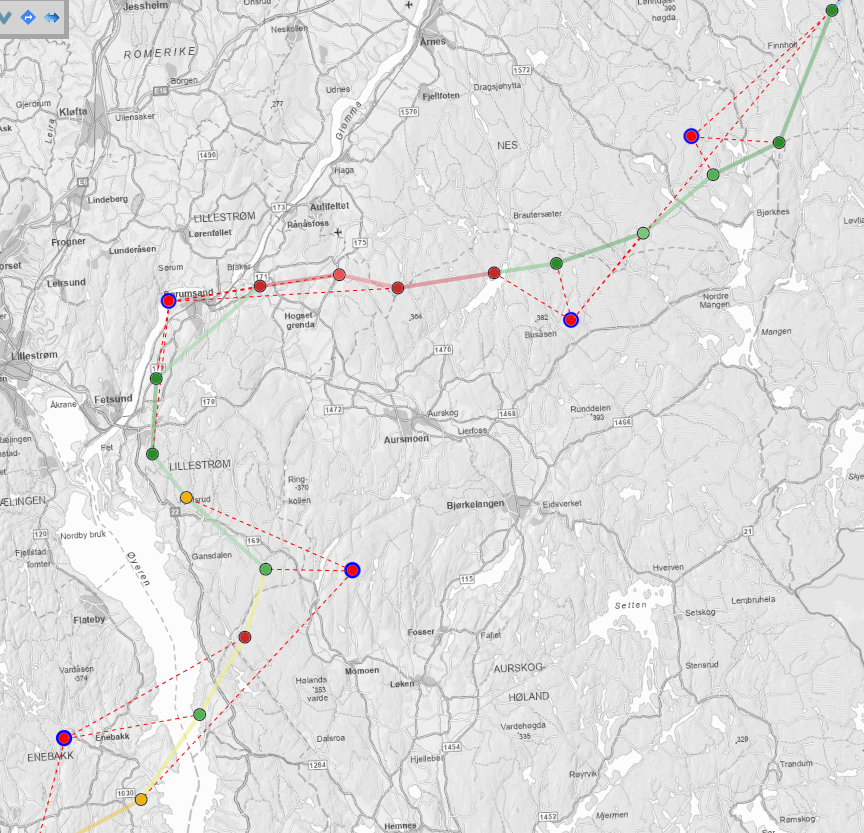
Below is an example concept showing a route and its evaluated radios.

The visualization typically contains:
- The plotted route (polyline) with a color marking the strength of coverage based on the signal level legend
- Icons marking radio locations
- Per‑point best‑coverage assignment
- (Optional) vectors from points to their respective best radio